Huzurabad Net
The men of Huzurabad wearing lungis woven by the women of huzurabad Towel weaving, Huzurabad, 2019
Mosquito Net, Huzurabad, Karimnagar District, Telangana Hand-spun cotton · Handloom woven
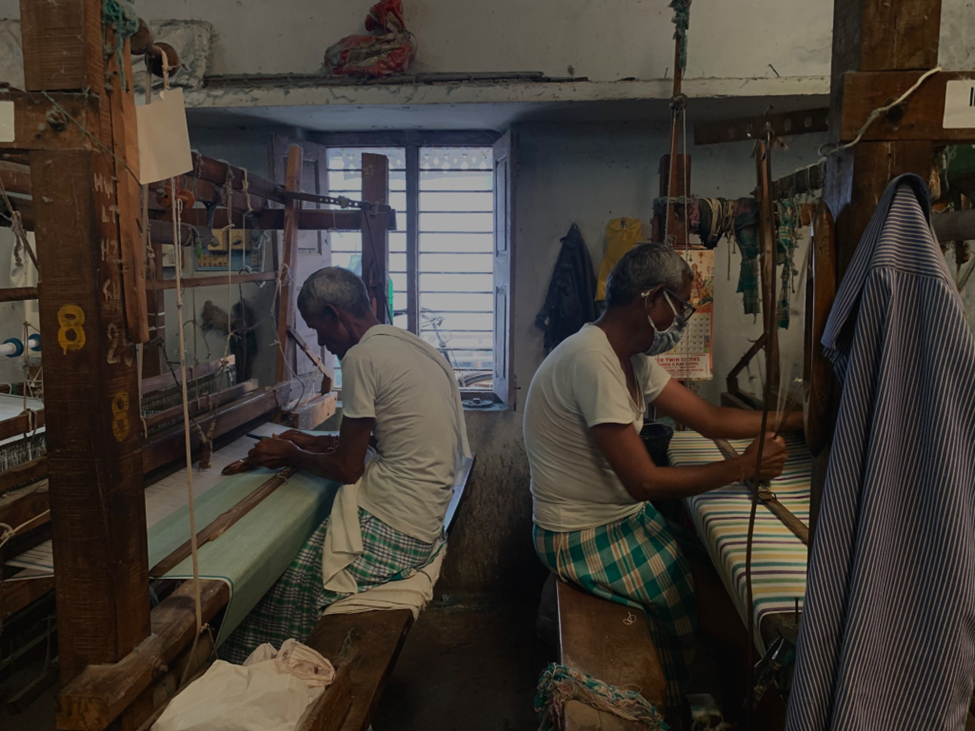
Rooted in the ancient textile traditions of the Deccan plateau, the handloom weaving communities of Huzurabad, Sircilla, and the wider Karimnagar district have produced cotton textiles for generations. This mosquito net is woven from hand-spun cotton, a fibre that connects the maker to the cloth from its very first thread. The community divides its labour: women spin the yarn and weave lighter-weight goods such as towels and fine cotton cloth, while men take on heavier weaves including bedsheets.
The open checkered pattern, achieved through a deliberately loose weave, is not merely decorative. Each square of the grid serves as a passage for air, allowing the sleeper beneath to breathe freely through the region's warm nights, protection and ventilation woven into one.
Weavers in Huzurabad and Karimnagar have long worked as a household industry, sustaining a craft that remains inseparable from daily life. This net is both a functional object and a quiet testament to a community's enduring skill.
For enquiries and collaborations please contact the artisans
Mr. Vaikuntam
+91 8019480092
Artisan Contact
Pochampally Ikkat
The meticulous dyeing of the warp.
Pochampally Ikat, Pochampally, Yadadri Bhuvanagiri District, Telangana | Hand-spun cotton and silk | Handloom woven | Warp and weft resist dyed
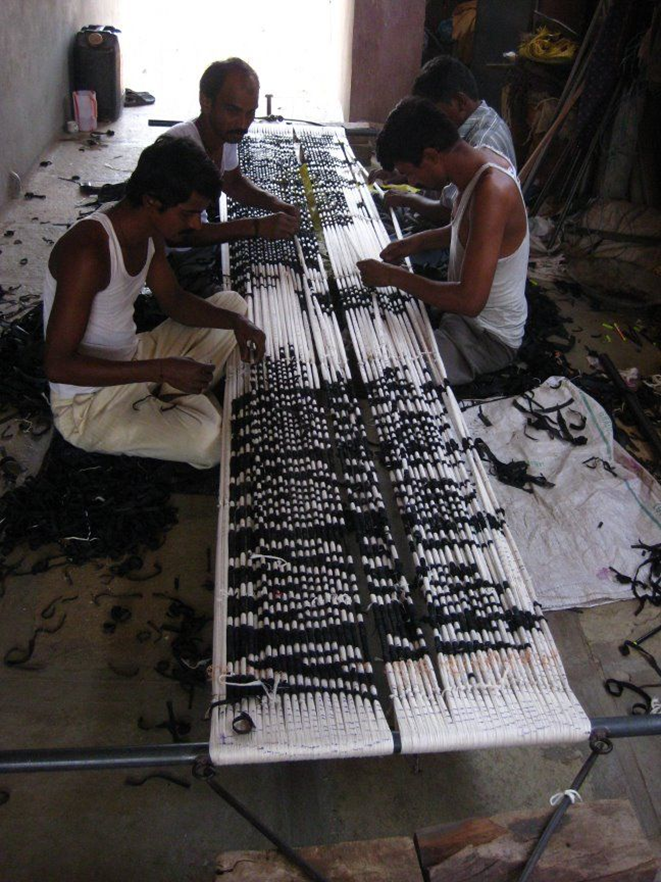
The word ikat comes from the Malay-Indonesian mengikat, meaning "to tie" or "to bind." Before a single thread meets the loom, it must first be bound, resisted, and transformed by dye. The pattern is decided before weaving begins, encoded into the thread itself.
Evidence of ikat appears across civilizations at roughly similar points in history, leading scholars to debate whether it has a single point of origin that spread through trade, or whether it was independently invented in multiple places simultaneously. The strongest case for a point of origin, however, has been made for Southeast Asia and the Indian subcontinent, given the density of weaving clusters and the significance of Indian Patola in the spice trade. Trade did not merely carry the textile; it shaped it, carrying geometry and colour across oceans and into new hands.
In Pochampally, the textile plays a significant cultural, historical, sociopolitical, and economic role. What distinguishes the village's ikat is its precise geometry. In single ikat, either the warp or weft threads are resist-dyed before weaving. In double ikat- Pochampally's most demanding expression, both are independently dyed and then aligned on the pit loom so that pattern meets pattern exactly at the point of interlacement. There is no correcting a miscalculation: the error is woven in, or the cloth begins again.
The motifs speak their own dialect: the chowka (square), the rekha (line), honeycomb tessellations, and chevrons rendered in natural dyes- indigo, turmeric, and pomegranate rind.
Today, cotton ikat is quietly being pushed out of production as silk commands higher returns. Fast fashion has begun reproducing the blurred, feathered edges of resist-dyeing as digital inkjet prints, the aesthetic borrowed, the labour erased. A pattern that takes a weaver three days to calculate is replicated in seconds. This cloth is both a technical achievement and a thread that runs from the spice routes of the ancient world to families in a district in Telangana who still speak its language.
Telia Rumal
The signature red, black and white palette.
Telia Rumal, Pochampally, Yadadri Bhuvanagiri District, Telangana | Hand-spun cotton | Handloom woven | Warp and weft resist dyed | Oil pretreatment
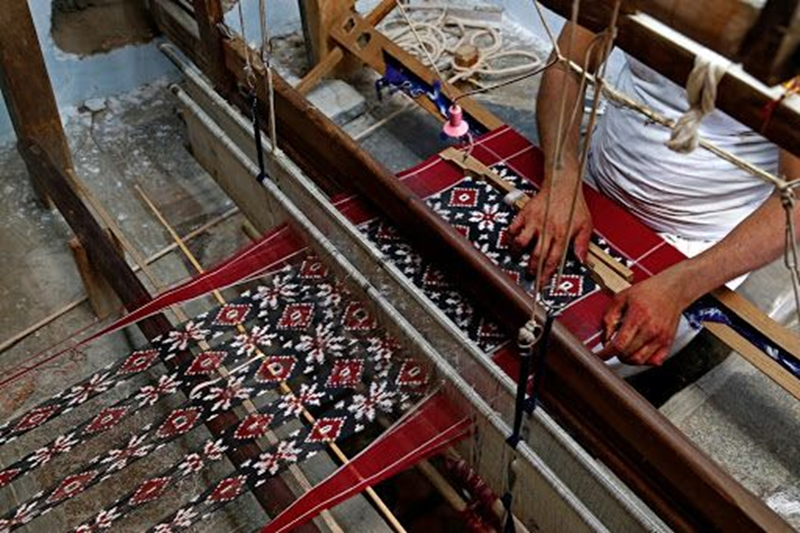
The word telia derives from the Sanskrit word taila, meaning sesame oil. Rumal traces to the Persian rūy māl - literally "face wiper," a term that entered the subcontinent through centuries of trade and courtly exchange, coming to denote a square cloth. Together, the name describes both what this textile is and how it is made: an oil-treated cloth. The oil treatment is not merely preparatory — it is the source of the cloth's legendary durability. The treated fibre resists moisture and wear, allowing the textile to outlast ordinary cotton by generations.
Before a single thread meets the loom, the yarn is steeped in a bath of castor oil and alkaline solution, a process called teli treatment; which opens the fibre to receive dye with unusual depth and permanence. The cloth is then resist-dyed using the warp-ikat method, its geometric motifs - concentric borders, medallions, and angular interlocking forms, all encoded into the thread before weaving begins.
Telia Rumal was historically prized for its cooling properties against skin, a quality first recognised by fishing communities along the Coromandel Coast, who wore it as a head covering against the coastal heat. By the nineteenth century, it had become one of the region's most significant export textiles, carried along trading routes to the Gulf and West Asia, where it was worn as a headscarf and gifted as a mark of status.
The palette of Telia Rumal is deliberately restrained: deep madder red, dense lamp black, and ivory white, occasionally joined by indigo. These were not arbitrary choices. Red and black, derived from alizarin and iron-based dyes respectively, bond with the oil-treated fibre with exceptional tenacity, resisting fading across decades of use. The combination carried visual weight legible across cultures, bold enough to read as status in a West Asian market, familiar enough to travel. The motifs include the chowka or square, rosette medallions, and interlocking angular borders that echo tilework and carpet patterns from Persia to the Deccan, a visual grammar shaped as much by the markets this cloth was made for as by the hands that wove it.
Today, very few weavers retain command of the full process. This cloth is a technical document of the Coromandel's mercantile history, as much as it is a textile.
Gadwal
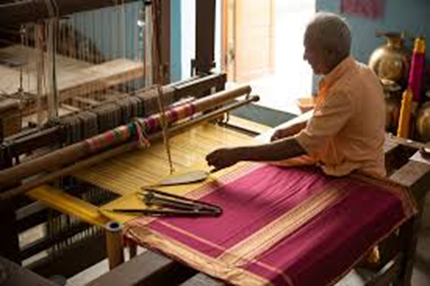
The traditional three shuttle loom looks to be almost a part of the weaver
Gadwal Saree, Gadwal, Jogulamba Gadwal District, Telangana Cotton and silk · Handloom woven · Interlocked weft
Gadwal's weaving tradition took root under the patronage of the Gadwal Samsthanam, a princely estate whose rulers actively drew master weavers into the town and sustained their craft across generations. By the nineteenth century, Gadwal sarees were moving through the courts of the Deccan, worn by women who understood that what they were wearing was not merely silk, it was a conversation between two entirely different materials- silk and cotton.
That conversation has a name: Kuppadam. The body of the saree is woven in fine cotton, breathable, austere, practical; while the border and pallu are executed in silk, heavy with zari. These are not two fabrics stitched together. They are woven simultaneously on a three-shuttle loom, one shuttle carrying the cotton of the body, two managing the silk border on either side. The weaver works all three in sequence, row by row, without pause.
What makes this structurally remarkable is the interlocked weft. At the precise boundary where cotton meets silk, the weft threads of each zone loop around one another before returning into their own fabric. There is no seam. There is no join in the conventional sense, only an interlacement so fine it is invisible to the eye, yet strong enough that the two cloths will not separate in wear or wash.
Today, power-loom imitations reproduce the visual contrast of cotton and silk but cannot replicate the interlock. The boundary gives it away, a seam where there should be a conversation.
Motifs-
Peacock- known as the nemali in Telugu appears in temple sculpture, classical dance, and textile borders as a symbol of grace, monsoon abundance, and Krishna. In handloom traditions, its spread tail remains a weaver's most demanding test of skill.
Swan- known as the hamsa in Telugu, represents the discerning soul capable of separating truth from illusion. Its presence on saree borders symbolizes clarity of thought.
Rudraksha- The bead is the seed of Shiva, worn across Telangana as a mark of faith and protection. Woven into borders as a repeating spherical motif, it transforms a garment into something sacred.
Mango - Known in Telugu tradition as the mavidam puvvu, the mango motif is among the oldest recurring forms in South Indian textiles; its curved teardrop shape representing fertility and the abundance of the land.
Gopuram - the gopuram once marked the highest point of a settlement, a visible anchor of both divine and human presence that oriented communities and instilled a sense of safety and belonging. To see a gopuram on the horizon was to know where you were. Woven into a saree, the motif carries that same grounding quality, a reminder of the temple's enduring place at the centre of life in Telangana
Leaf- Drawn from the pipal, tulsi, and banana plants that thread through daily worship, the leaf motif represents life and auspiciousness. In weaving, it serves as a quiet reminder that the sacred and natural are inseparable in this culture.
Nandi - the sacred guardian of Shiva, is inseparable from the religious identity of Telangana, a region steeped in Shaivite tradition. His presence on a textile signals devotion and belonging to Shiva.
Elephant- Simultaneously royal and divine, the elephant evokes both Ganesha and the ceremonial temple procession. In textiles, its broad form fills a border with grandeur and occasion that few other motifs can match.
Deer - Associated with the forest and innocence. Through the Ramayana's golden deer, it also marks the thin boundary between beauty and illusion.
For enquiries and collaborations please contact the artisans-
Mr. Satish (TGSCO)
+91 8688443471
Artisan Contact
Narayanpet
The weaver in the pit loom
Narayanpet Textiles, Mahabubnagar district, Telangana Cotton and silk · Handloom woven
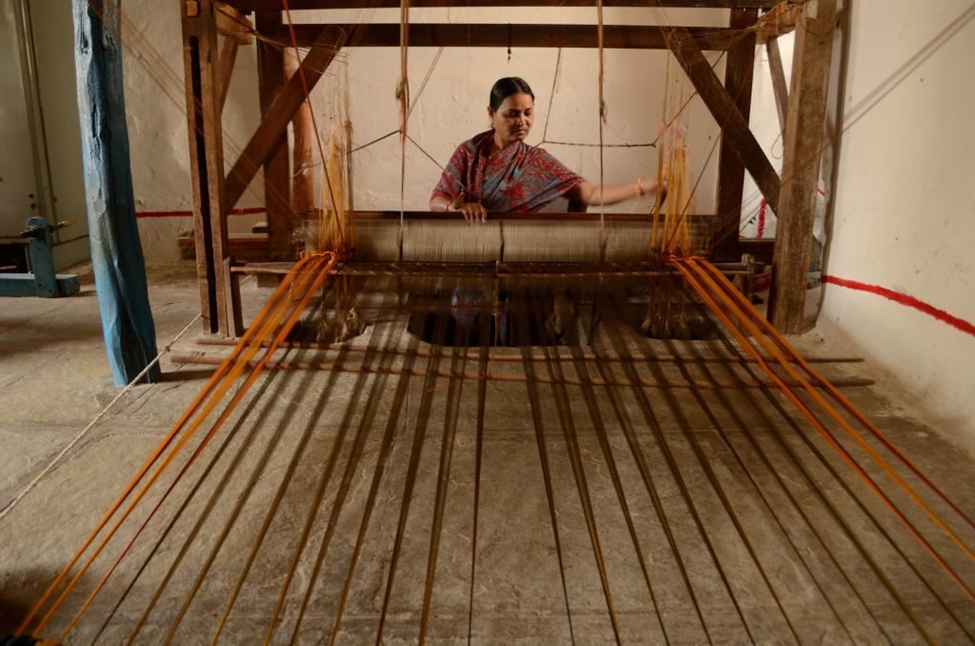
Narayanpet, a weaving town in Mahabubnagar district, Telangana, has produced its distinctive cotton-silk textiles for over three centuries. Community oral histories hold that the settlement's weaving lineages trace back to the 17th century, when Chhatrapati Shivaji passed through the Deccan region, weavers, it is said, settled here in the wake of that movement. Whether migration or slow accumulation, the tradition consolidated during the Nizam period, when royal patronage established a culture of refined domestic textiles woven for gifting and ceremonial use.
What distinguishes Narayanpet cloth is its structural clarity: cotton forms the ground, silk carries the border and pallu, and the contrast between the two gives the sari its characteristic weight and drape. This is not an accident of technique but a deliberate aesthetic, matte field against luminous edge.
The fabric is produced on pit looms, where the weaver sits below floor level, working the treadles with the body as much as the hands. The geometry of the borders, typically running checks or ruled stripes, is calculated before a single thread is stretched; once begun, there is no revision. The pattern is structural, not applied. It is woven in.
Motif
Rudraksha- The bead is the seed of Shiva, worn across Telangana as a mark of faith and protection. Woven into borders as a repeating spherical motif, it transforms a garment into something sacred.
Peacock- known as the nemali in Telugu appears in temple sculpture, classical dance, and textile borders as a symbol of grace, monsoon abundance, and Krishna. In handloom traditions, its spread tail remains a weaver's most demanding test of skill.
For enquiries and collaborations please contact the artisans-
Mr. Satish (TGSCO)
+91 8688443471
Artisan Contact
Gollabhama
The women of siddipet, immortalised by the artisans of siddipet
Gollabhama Textiles, Siddipet, Telangana Hand-spun cotton · Handloom woven · Block-printed or resist-dyed
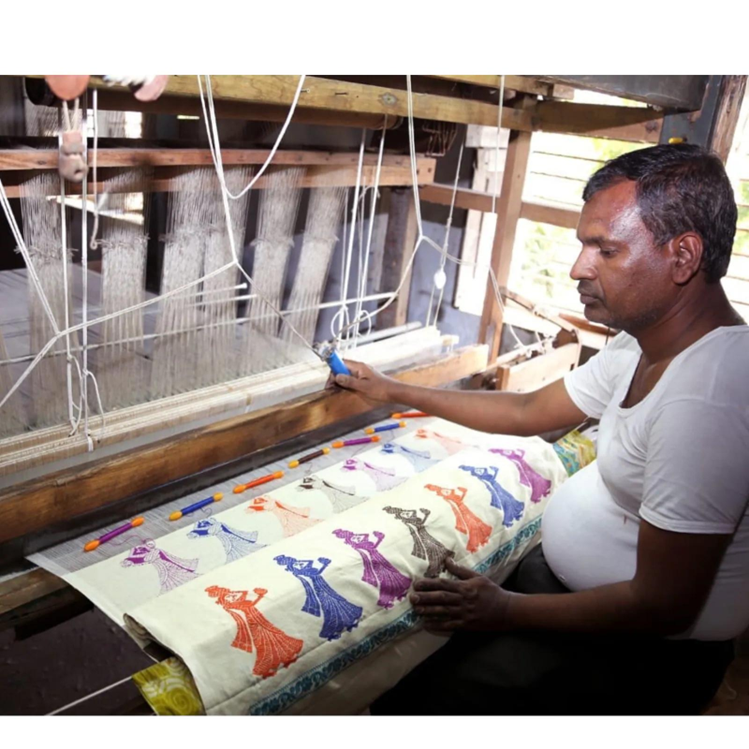
Before the cloth is worn, it is already a story. Gollabhama — named for the golla women, the pastoral cowherd communities of Telangana — is a hand-spun cotton textile depicting the women of the community it comes from.
The golla communities have long held a sacred association with Lord Krishna, himself a cowherd. Their textiles carry a reverence for the profession, with painstakingly woven symbols of women carrying milk.
Within Telangana's cultural calendar, Gollabhama cloth holds particular significance during Bathukamma, the state's flower festival, worn by women as an expression of regional identity, seasonal rhythm, and collective memory.
Today, as synthetic fibers undercut hand-spun cotton and festival dress turns to imitation prints, the Gollabhama weave risks becoming an image without inheritance, the pattern surviving, the knowledge fading.
Motif
Milkmaid- Also known as the gopika, appears in Gollabhama textiles as a figure mid-stride, pot balanced on head, embodying both the daily labour of pastoral life and the devotional world of the Bhagavata Purana, where the gopikas of Vrindavan are inseparable from Krishna's story. She is a celebration of real and mythical women.
For enquiries and collaborations please contact the artisans-
Mr. Satish (TGSCO)
+91 8688443471
Artisan Contact
Warangal Dhurries
The vibrant floors of Warangal.
Warangal Dhurries, Warangal, Telangana | Hand-spun cotton | Flat-woven | High density flat weave
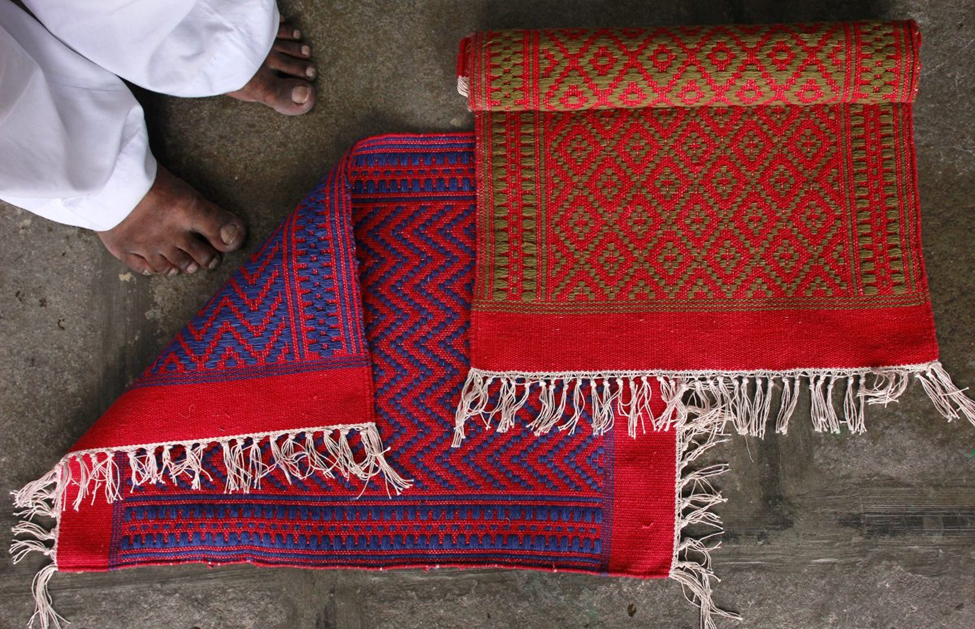
The dhurrie in Warangal carries within it a history that moves between court, colony, and everyday life. Its present form is often traced to the patronage networks of the Mughal period, when skilled weavers migrated and settled in regions that could sustain large-scale production. Warangal, with its abundant cotton and established weaving communities, became one such centre. Here, the loom met raw material with ease, and a durable, utilitarian textile began to take shape.
The earliest iterations of the dhurrie are closely tied to prayer mat weaving. Flat-woven, lightweight, and reversible, they were designed for portability and use across spaces, mosques, homes, and courts. Over time, the dhurries became more than their function, they became prized for their form. Because dhurries are flat-woven and reversible, the dyes needed to be deeply absorbed and durable, rather than surface-level. The emphasis was less on vibrancy and more on longevity and stability, especially given their use as floor coverings. Traditionally dyes from Indigo, madder, aal, pomegranate rind and iron based solutions were used.
By the late 19th century, Warangal dhurries had entered global circuits. Exhibited in London, they drew attention for their unusually high weave density and clarity of pattern, qualities that distinguished them from other flat weaves. In colonial records, they were at times referred to alongside prized Indian exports, sharing a stage with objects taken from this land by the empire like the Koh-i-Noor.
To meet colonial demand, the British pushed production extended into prisons, driving the cost of production down. This system disrupted traditional weaving economies. Independent weavers, working from homes or small workshops, could not compete with the low-cost, regimented labour of prisons.
Today, Warangal dhurries are woven for both domestic use and export, with demand from European markets shaping scale and palette. What endures is their quality, the textile remains grounded in cotton, geometry and bold colors.
For enquiries and collaborations please contact the artisans
Mr. Mallika Arjun
+91 9849382861
Artisan Contact
Matchbox Sarees
Matchbox Saree, Sircilla, Rajanna Sircilla District, Telangana | Silk or lotus fibre | Power loom woven | 6 meters fit in a matchbox
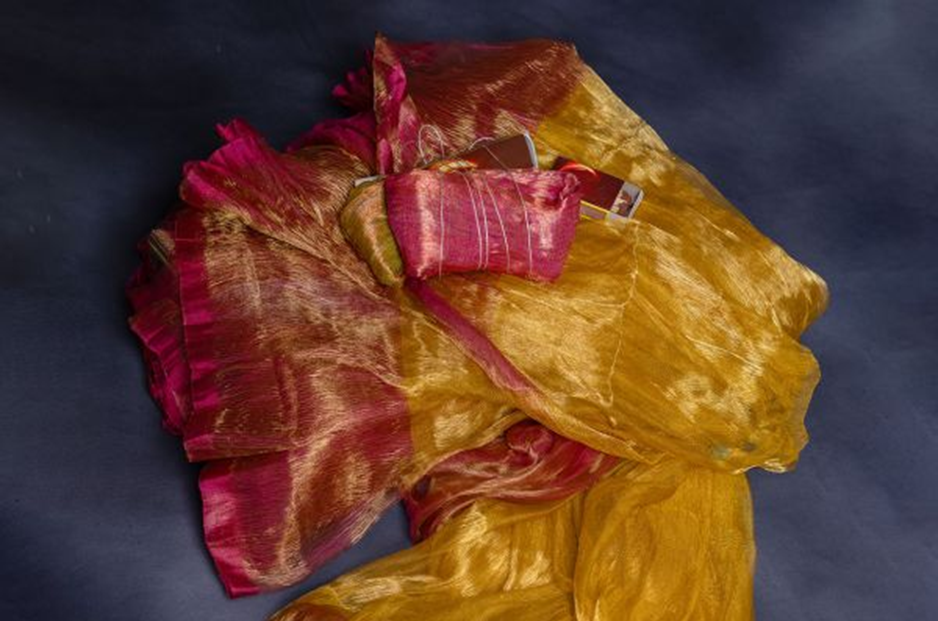
Remarkability: A saree is among the longest continuous lengths of cloth a body can wear, typically five to nine metres. The Sircilla Matchbox Saree folds in its entirety into a rectangle no larger than a standard matchbox: approximately 5.5 cm by 3.5 cm, and no more than 1.5 cm thick when sealed. It can be drawn through a finger ring, held between two fingertips, or mailed inside an envelope.
This is not a craft of the hand loom. The Matchbox Saree is woven on a specialised jacquard power loom, calibrated to a thread count and tension that no conventional machine can sustain. A single saree requires between eight and twelve hours of continuous, monitored production. The loom itself must be reconfigured for the weave, the margins for error in thread tension are measured in microns. The weaver is as much technician as artisan.
The cloth is produced in silk and, increasingly, in lotus fibre, a material extracted from lotus stems, thread by thread, prized for its natural lustre and hypoallergenic quality. India's textile traditions have long prized extreme fineness: the vanishing-weight muslins of Dhaka and the woven-air mul of Bengal established that cloth could be measured not by its presence but by its near-absence.
The Sircilla Matchbox Saree belongs to a younger lineage, a post-independence innovation, sharpened by competition and civic pride into a technical statement.
For enquiries and collaborations please contact the artisans
Mr. Vijay Kumar
+91 9866929019
Artisan Contact
Natural Dyes of Telangana
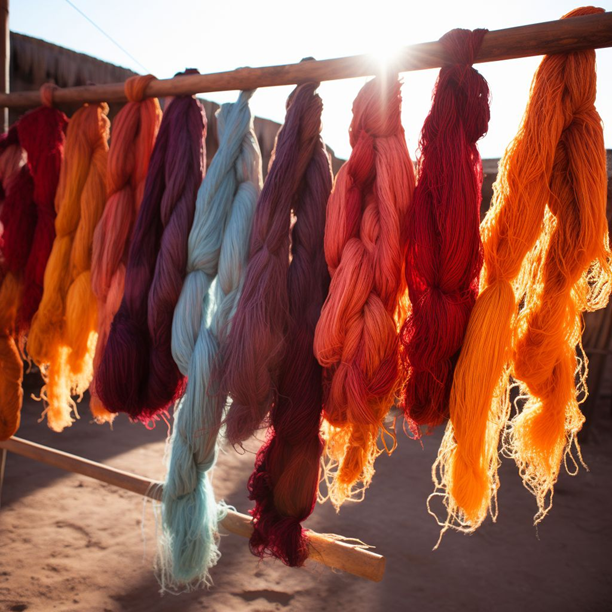
Telangana's natural dyeing tradition represents centuries of ecological wisdom, drawing on plant sources like indigo, madder, marigold, and neem bark to produce textiles that are biodegradable, non-toxic, and rich in medicinal properties. Unlike synthetic dyes, these pigments carry antimicrobial and therapeutic qualities, making the fabrics inherently beneficial to wearers and the environment alike.
Dr. A. Sarada Devi has been instrumental in reviving this heritage, developing over 10,000 dye shades, earning three patents, training 1,300+ artisans, and empowering 5,000 indigo farmers. Her startup, Vishwa Natural Fab Prints, now mechanizes sustainable natural dyeing at scale.
Annatto
a.k.a Bixa orellana
Introduced through colonial trade networks, Annatto quietly wove itself into South Asian dyeing traditions. Known locally as latkan or sinduri, its warm orange and ochre tones found favour among textile artisans seeking accessible, lightfast colour. Beyond cloth, it coloured ritual powders and foods, a vivid immigrant that became, in time, unmistakably local.
Marigold
a.k.a Calendula and Tagetes
Marigold species have coloured South Asian textiles for centuries, yielding warm golds and ambers through their flavonoid-rich petals. In Telangana, marigold garlands remain inseparable from ritual and celebration. Here, the flower is simultaneously offering, ornament, and dye, one of nature's most generous pigments.
Indigo
a.k.a Indigofera tinctoria,
Indigo has coloured human civilization for over five millennia. In Telangana, its cultivation shaped agrarian landscapes and trade networks long before colonial extraction intensified demand. This "blue gold" bridged ancient dye-vats and global commerce, making India the world's most coveted source of an irreplaceable, luminous hue.
Sappanwood
a.k.a Biancaea sappan
Prized for centuries across South and Southeast Asia, sappanwood yields a rich crimson dye from its heartwood, derived from the compound brazilin. In Telangana and broader India, it coloured textiles, medicines, and ritual objects alike, a color woven through trade, craft, and culture long before synthetic dyes dimmed its legacy.
Pomegranate rind
a.k.a Punica granatum
The sun-dried outer rind of the pomegranate yields a rich greenish yellow dye prized across South Asia for centuries. In Telangana, it historically coloured cotton and silk in both domestic and courtly contexts. Rich in tannins, the rind also acts as a mordant, binding other dyes and deepening their permanence on cloth.
Arjun bark
a.k.a Terminalia arjuna
The bark of the Arjun tree yields warm earthy tans and browns through tannin-rich extracts. In Telangana's textile traditions, it subtly enriches natural fabrics, binding colour to cloth, quietly, durably, and without artifice.
Madder
a.k.a Rubia tinctorum & Rubia cordifolia
Prized for millennia, madder's roots yield alizarin, a vivid red dye foundational to South Asian textile traditions. In Telangana, it coloured the celebrated ikat weaves of Pochampally. A pillar of trade between India and Europe, madder shaped economies long before synthetic dyes rendered it nearly obsolete in the late nineteenth century.
For enquiries and collaborations please contact the researchers and artisans-
Dr. A. Sarada Devi
+91 7993196710
Artisan Contact
Malkha
Content forthcoming.
Himroo
The traditional boteh of Himroo
Himroo, Hyderabad, Telangana Cotton warp · silk or cotton weft · handloom woven
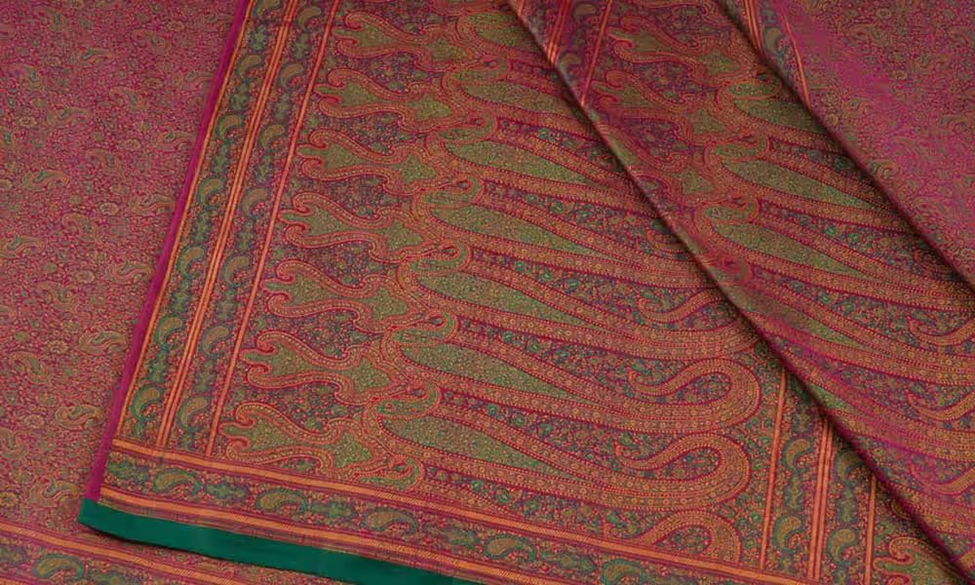
The word Himroo derives from the Persian hum-ruh, meaning "similar to" or "a substitute for"; an etymology that contains its entire history. It was created as an accessible alternative to Kimkhwab (meaning “a little dream” ); the dense gold-and-silver brocade woven for Mughal courts. Pure silk warps interlaced with zari in complex supplementary weft structures that demanded extraordinary time, skill, and bullion. Himroo simplified this architecture deliberately: cotton replaced silk in the warp, reducing cost and loom tension, while the supplementary weft- the thread that carries the pattern- retained silk or finer cotton. The result preserved the visual density of brocade at a fraction of the expense.
In traditional brocade, pattern threads must be individually manipulated across the full width of the cloth at every pass, often requiring a drawloom and a second weaver to lift the correct warp threads. Himroo uses a handloom with a dobby or jacquard attachment, encoding the repeat mechanically.
The motifs on Himroo include- boteh (the teardrop form that later became the paisley), kalga, arabesque floral scrolls, and geometric lattices. These arrive directly from Persian court textile traditions, carried into the Deccan through the Bahmani Sultanate and later consolidated under the Nizams of Hyderabad. The same workshops that served Hyderabad's court extended their craft to Aurangabad under Mughal patronage, embedding the textile in both regions simultaneously.
Today, Himroo holds Protected Geographical Indication status in both Maharashtra and Telangana.. These days Himroo faces quiet erosion: the jacquard cards that hold its patterns are rarely reproduced, and with each card lost, a motif disappears. What survives is not merely cloth. It is a record of democratization and innovation.
For enquiries and collaborations please contact the artisans-
Ms. Zeenath
+91 9347202875
Artisan Contact
Warangal Bobbin Lace
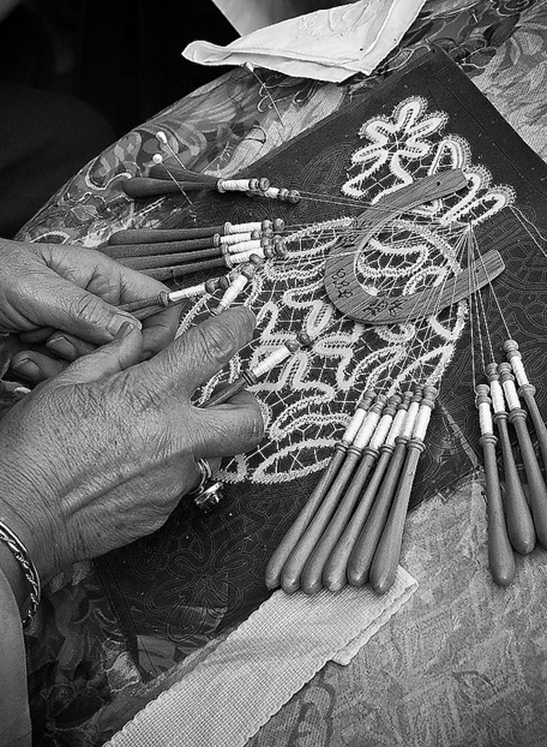
The hands that control the pattern
Warangal Bobbin Lace, Station Ghanpur, Jangaon District, Telangana Mercerised cotton thread · Handmade bobbin lace
The first written record of bobbin lace places its origin in Venice, dated to 1536. Developed in the early 16th century across the Venice and Milan regions of Italy, the technique spread rapidly. Women throughout Europe soon took up the craft, which earned a better income than spinning, sewing, or weaving, other home-based textile arts available to them. On the islands near Venice, lacemaking wives and daughters bore much of the household's financial burden through their bobbin work. By the 17th century, Flanders and Normandy had become the new centres of excellence, and lace had woven itself into the economic fabric of the continent.
The technique was carried globally by emigrants, missionaries and colonial educators who taught it to women across the Americas, South Asia, and beyond. In the Warangal region, bobbin lace was introduced by Christian missionaries whose vestments were decorated with lace. Father Augusto Colombo introduced the craft as an occupational art at Station Ghanpur in the mid-twentieth century, exporting finished work to Europe ( primarily Italy) until his death in 2009, after which the cluster lost its commercial anchor.
To make this lace is to perform mathematics with one's hands. Bobbin lace is a fibre art form in which intricate patterns are created by braiding together many threads according to sequences held entirely in the maker's memory ( cross, twist, cross, twist) executed across dozens of bobbins simultaneously. Researchers studying the craft have described its practitioners as human computers: the craft embodies algorithmic rules, and translating it into discrete, computable steps reveals the implicit knowledge held within the hands of craftspeople. A single piece of 22 cm diameter lace requires between 35 and 40 working hours, varying with the maker's skill and the intricacy of the design.
No machine has replicated this. Industrial looms can approximate the visual texture of lace, borrowing its aesthetic while erasing its logic. But bobbin lace is not a pattern applied to fabric, it is the fabric, structure and surface built simultaneously, stitch by stitch, decision by decision. What takes a lacemaker forty hours to compose is not just a product. It is a record of thought, made visible in thread.
From the Venetian islands to the convents of Telangana, this cloth has always been made by women, for survival, for devotion, for beauty.
For enquiries and collaborations please contact the artisans-
Ms. Sulochana Edla
+91 9676669625
Artisan Contact
Lambadi Mirror Work
Art and the artisan
Lambadi Mirror Work Cotton khadi · Hand embroidery · Mirror, cowrie shell, and coin embellishment
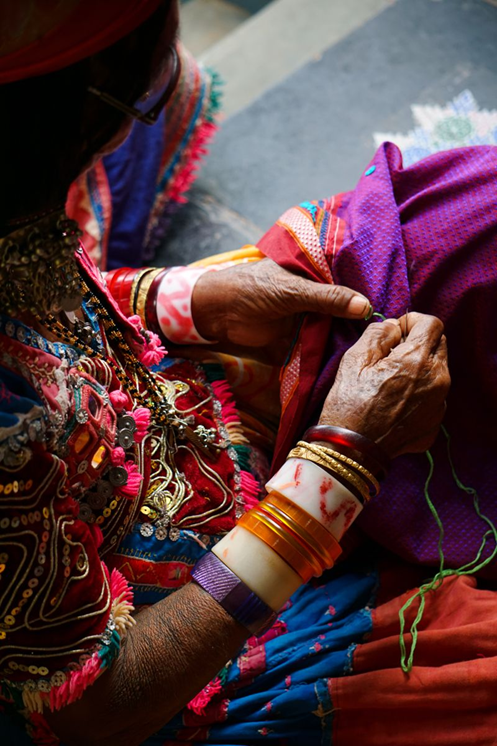
Among the Lambadi, also known as Banjara or Lambani, embroidery is not ornamentation alone; it is biography, belief, and protection stitched into cloth. The Lambadi are a community whose migrational history traces from Afghanistan through Rajasthan and Gujarat, spreading across the Deccan plateau as semi-nomadic traders who transported salt and goods across the subcontinent. The craft travelled with them, portable, identity-bearing, and essential.
The mirrors stitched onto garments served a practical function in forest camps: their specular reflections scared away wild animals, while also helping identify Lambadi women to other community members across distance. Beyond the physical, mirrors are believed to deflect the nazar, the evil eye, turning the gaze of harm back upon itself. Cowrie shells and coins are stitched onto fabric as symbols of prosperity, and the community, traditionally avoiding cash as traders, embedded wealth directly into women's dress.
Lambani embroidery employs fourteen named stitch types — Kilan, Vele, Bakkya, Maki, Suryakanti Maki, Kans, Tera Dora, Kaudi, Relo, Gadri, Bhuriya, Pote, Jollya, and Nakra — most following strict geometric logic: squares, circles, triangles, rectangles, diagonal and parallel lines arrayed in dense, repeating sequence. The Suryakanti Maki — sunflower seed stitch — gestures toward the flower through its spiralling structure; the Nakra builds a small crocodilian diamond from four straight lines; the Kans evokes the dense reed grass of riverbanks in its fine, parallel rows.
Lambadi women make these textiles primarily for their own traditional dress and for giving to their daughters at marriage. The trousseau is not purchased, it is accumulated, stitch by stitch, across years. A mother teaches a daughter; the daughter carries the knowledge, and eventually the cloth, into her own household. Young girls are assigned simpler lines and designs, learning from their mothers by working on small sampler pieces, while the more intricate detailing is entrusted to older, experienced women.
This is a textile that has crossed deserts, forest camps, and centuries — and has not yet stopped moving.
For enquiries and collaborations please contact the artisans-
Ms. Ketavath Laxmi
99510 22375
Artisan Contact
Ahimsa Silk
Ahimsa Silk, Hyderabad, Telangana Peace Silk · Wild Silk · Non-violent Silk
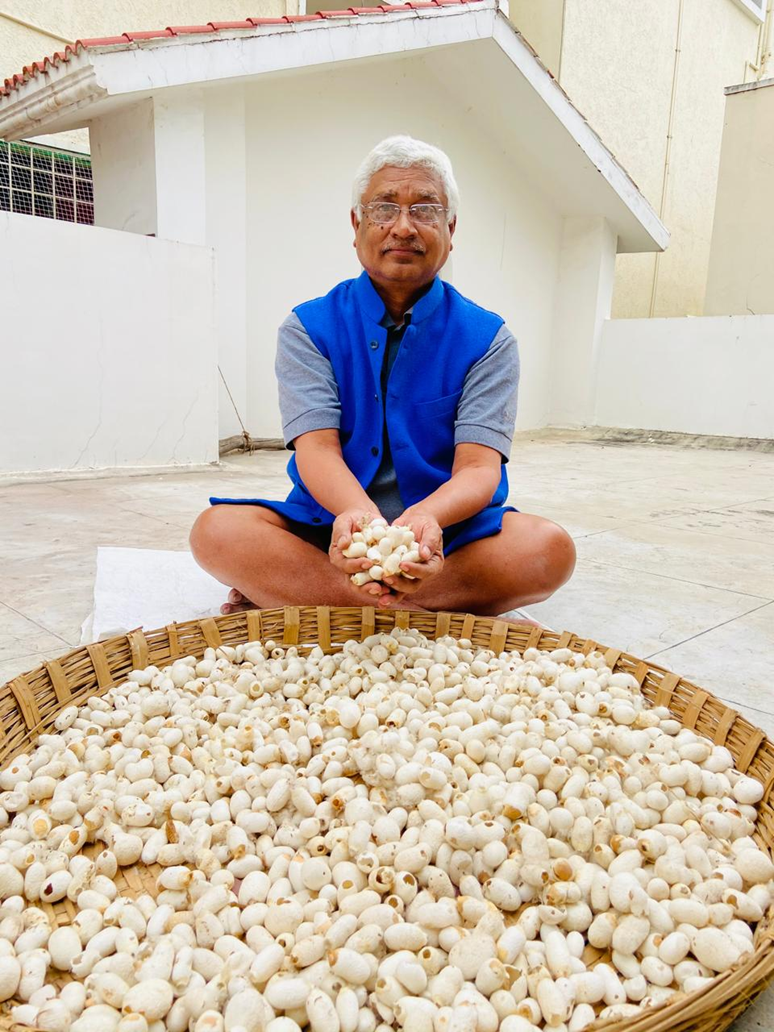
The word ahimsa derives from Sanskrit, a (non) and hiṃsā (harm), the ancient principle of non-violence central to Hindu, Buddhist, and Jain thought. That it names a textile tells you everything about what makes it different.
Conventional silk is produced by boiling cocoons while the silkworm pupates inside, killing the moth to harvest a continuous filament. Ahimsa silk waits. The moth is allowed to emerge naturally, breaking the filament in the process. The resulting shorter fibres are then spun together, closer in technique to cotton spinning than to traditional silk reeling.
The fabric has older roots in India's wild silk traditions- eri, tussar, and muga, where forest-gathered cocoons were processed after emergence. What Mr. Kusuma Rajaiah, a former civil servant from Telangana, contributed to was method and scale. In 2004, he received a patent for a standardised process of producing peace silk commercially, translating an ethical intention into a replicable technique. His work made it possible to bring ahimsa silk from craft practice to market without sacrificing the principle embedded in its name.
The cloth carries a slightly textured, matte hand, less lustrous than conventional silk, more tactile. What it withholds in sheen, it holds in meaning.
For enquiries and collaborations please contact the patent holder-
Mr. Kusuma Rajaiah
+91 94901 61897
Artisan Contact
Mahadevpur Tussar
Bhupalpally District, Telangana Wild silk , Handloom woven, Thigh-reeled yarn, Vegetable dyed
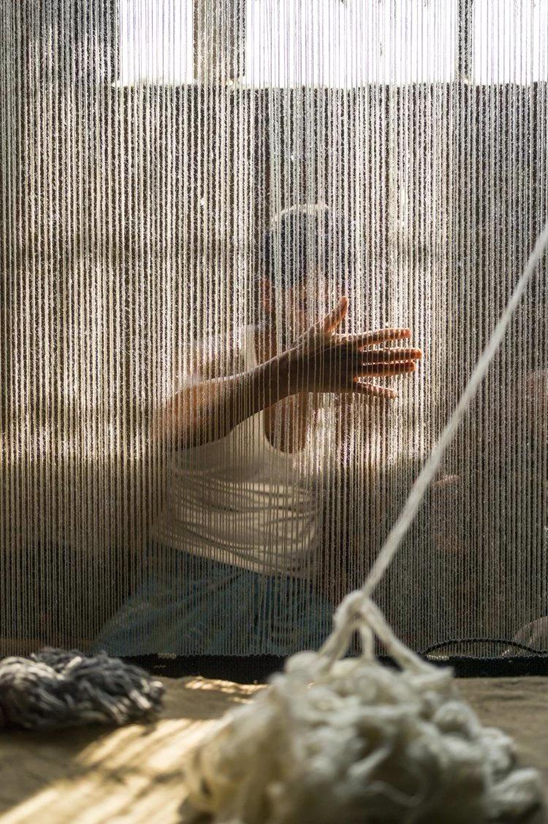
The word tussar traces to the Sanskrit tasara, meaning the weaver's shuttle, also known as kosa, or wild silk. Tussar fibres are harvested from silkworms of the moth genus Antheraea, which feed on Arjun and sal trees rather than mulberry. The resulting silk is three to four times stronger than mulberry silk , yet carries a rougher, more textured hand and is dull gold and earthy.
Traditionally, reeling tussar was an entirely manual process: threads, extracted by pulling and rubbing cocoons against the thigh or on a kharpa ( a clay tile) a method undertaken exclusively by women of the community. The yarn is then wound onto a charkha, dyed, stretched on a wooden frame, and brushed repeatedly with a natural starch gruel to strengthen it before it meets the loom.
Mahadevpur sits in the forested northeast of Telangana, near Kaleshwaram, and its weaving colony exists precisely because the forest does. The silkworms thrive on the leaves of trees in the surrounding forests, and cocoons are harvested once a year by forest-dwelling tribal communities, who supply them directly to the weavers. Implements used in processing are carved from the wood of the Tendu tree, which grows abundantly in the region, the forest not merely as backdrop, but as infrastructure.
Traditionally, weavers coloured the naturally ivory-hued silk using vegetable dyes derived from turmeric, alum, dried flowers, fruit peels, lac, and indigo. A single saree can take fifty hours to complete. The cloth that results is not precious in the way of ornament, it is also precious in the way of patience.
For enquiries and collaborations please contact the artisans-
Mr. Satish (TGSCO)
+91 8688443471
Artisan Contact
The Lakshmi Asu Machine
The Inventor and the invention
Lakshmi Asu Machine, Aler, Yadadri Bhuvanagiri District, Telangana Warping Machine
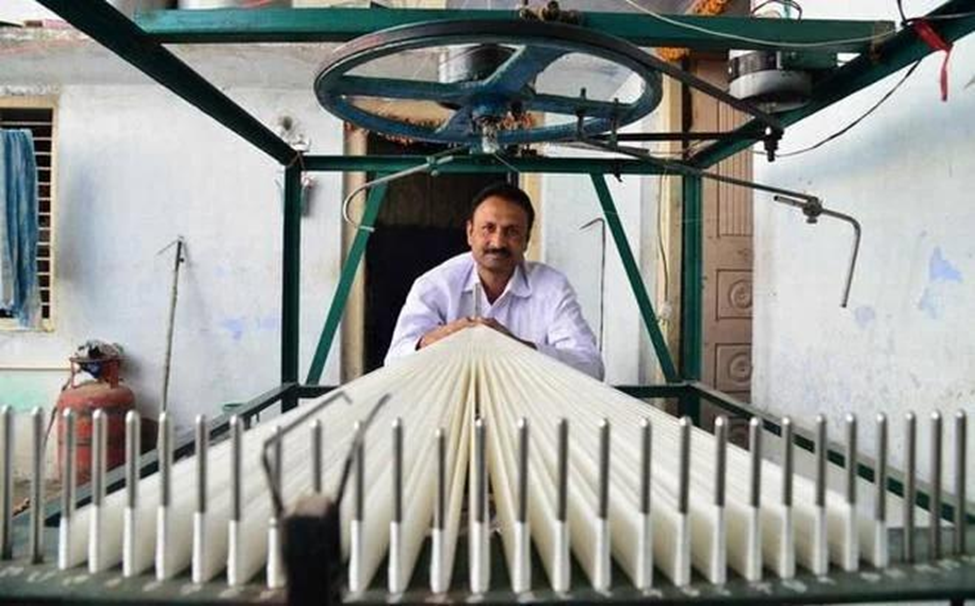
As a young boy in Aler village, Telangana, Mr. Chintakindi Mallesham watched his mother Lakshmi, a handloom weaver, labour for hours winding silk yarn onto a large frame in a process called asu, integral to crafting the celebrated Pochampally Ikat sari. The hand-winding process required the weaver to move their arm up and down over a space of one metre around semi-circularly arranged pegs approximately 9,000 times per sari, causing tremendous physical strain in the shoulders and elbow joints.
A Class VI dropout with no formal engineering knowledge, Mallesham spent seven years ( between 1992 and 1999), in relentless trial and error, studying machines in rice mills and local workshops, before arriving at his invention. He named it the Lakshmi Asu Machine after his mother.
The machine reduced the cycle time for preparing yarn from approximately six hours to around ninety minutes. This meant weavers could produce six saris instead of two per day, significantly increasing their earnings. Several women subsequently established dedicated Asu machine centres, generating new livelihood opportunities and reviving the slow-decaying Tie & Dye tradition of Pochampally.
Mr. Mallesham received the Rashtrapati Award in 2009, was named in Forbes' list of the seven most powerful rural Indians in 2010, and was conferred the Padma Shri, India's fourth-highest civilian honour in 2017. His story stands as a testament to how grassroots ingenuity can preserve cultural heritage while transforming lives.
For enquiries and collaborations please contact the inventor
Mr. Chintakindi Mallesham
+91 7989403563
Artisan Contact
Mr. Gajam Govardhana
Mr. Gajam Govardhana b. 1949, Puttapaka, Nalgonda District, Telangana Master Weaver · Telia Rumal · Double Ikat, Cotton and Silk · Oil-treated, resist-dyed, handloom woven
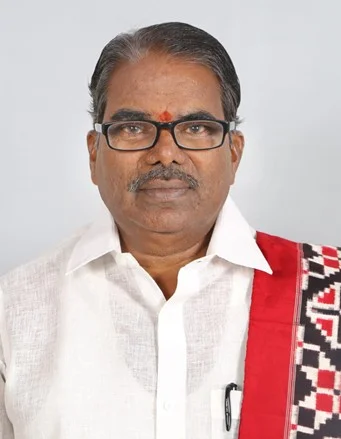
Mr. Gajam Govardhana grew up in Puttapaka surrounded by looms and thread, learning the craft alongside his father before weaving independently by the age of fifteen. The textile he would dedicate his life to was not yet his own. In 1975, while working for the Ministry of Textiles, he visited Chirala, where the Telia Rumal had nearly vanished; he resolved to bring it back.
The name carries its method within it: tel, oil; rumal, square cloth. Before dyeing begins, the yarn is treated with castor ash, sesame oil, and sheep dung, lending the finished cloth its characteristic texture, fragrance, and cooling properties. What follows is double ikat- both warp and weft independently bound, dyed, then aligned on the pit loom so that pattern converges precisely at interlacement.
When Mr. Govardhana began his revival, fewer than twenty families still practised the craft. He trained over 800 artisans, eventually employing 500 weavers and expanding the tradition into sarees, wall hangings, and carpets.
His 100-motif cloth, vast in scale, uncompromising in precision, is considered a modern masterpiece of Indian textile design. He received both the Padma Shri and the Shilp Guru Award from the President of India. UNESCO recognised his contributions to handicrafts, and in 2020, the Puttapaka Telia Rumal received its Geographical Indication tag.
For enquiries and collaborations please contact the inventor
Mr. Gajam Govardhana
+91 9848024642
Artisan Contact
Mr. Gajam Anjaiah
Mr. Gajam Anjaiah b. 16 May 1955, Puttapaka, Nalgonda District, Telangana Master Weaver & Handloom Designer · Telia Rumal · Double Ikat, Cotton and Silk · Oil-treated, resist-dyed, handloom woven
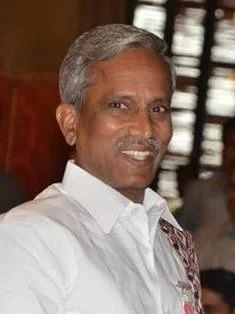
Mr. Gajam Anjaiah, the son of Mr. Narasimha, the weaver credited with bringing the Telia Rumal tradition from Chirala to the village. He inherited not just a craft but a responsibility: to carry forward what his father had rescued from near extinction. His family has produced traditional Telia Rumals since inception, preserving their original methods across generations.
Mr. Anjaiah began weaving under his father's guidance at the age of 13, shaping his practice around design as much as technique. Where the loom demands precision, his contribution was imagination, translating intricate motifs from paper onto cloth with a degree of calculation that few weavers attempted.
His most ambitious works push the tradition into new formal territory. A cotton saree bearing 16 auspicious symbols from Jain scripture, intended for festivals and religious occasions, and another carrying 108 astrological motifs, each rendered in just 2.25 inches of space, stand as remarkable exercises in miniature geometry and devotional design.
He has trained over 60 weavers across villages in Nalgonda and Mahbubnagar districts, in varieties including Gadwal, traditional Kancheevaram, Uppada, and Kota sarees, while providing regular employment to 200 weaver families, ensuring the knowledge does not remain confined to a single household. He received the National Award for his Telia Rumal saree in 1987, followed by the Sant Kabir Award in 2010, and the Padma Shri in 2013.
For enquiries and collaborations please contact the inventor
Mr. Gajam Anjaiah
+91 9963674099
Artisan Contact
Ms. Gajam Narmada
Ms. Gajam Narmada Proprietor, M/s Narendra Handlooms · Pochampally Ikat · Single and Double Ikat, Silk · Handloom woven
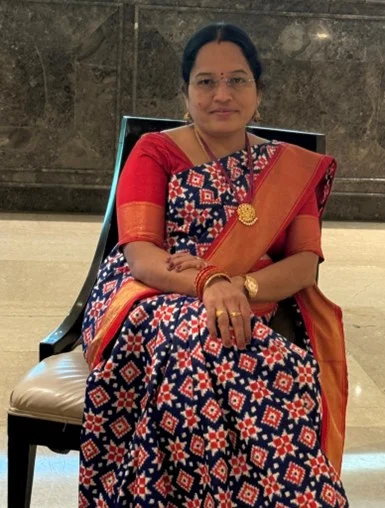
Ms. Gajam Narmada founded M/s Narendra Handlooms in 2013, building her enterprise from the ground up in Kothapet, Hyderabad. Where many in the handloom sector struggle to stay afloat, she has grown steadily, the firm's sales turnover has climbed year on year since 2020-21, and sustains employment for 300 handloom weavers across Telangana.
Her work centres on Pochampally Ikat silk sarees, both single and double ikat, produced in the weaving villages of Puttapaka, Ghatuppal, and Chandur in the districts of Yadadri Bhuvanagiri and Nalgonda. What sets her apart is the balance she strikes: honouring the structural rigour of ikat while responding to contemporary taste, introducing new colour combinations and design sensibilities that speak to younger buyers without loosening the craft's technical demands.
In double ikat, both warp and weft are independently resist-dyed before weaving; the pattern only resolves when the two align precisely on the loom. That Narmada manages this at scale, across hundreds of weavers, is itself a form of mastery.
In 2024, the Ministry of Textiles recognised her with the National Handloom Award in 2024 she won the Sant Kabir National Handloom Award.
For enquiries and collaborations please contact the inventor
Ms. Gajam Narmada
+91 9848690540
Artisan Contact